citeai.tech · guide
Does llms.txt work?
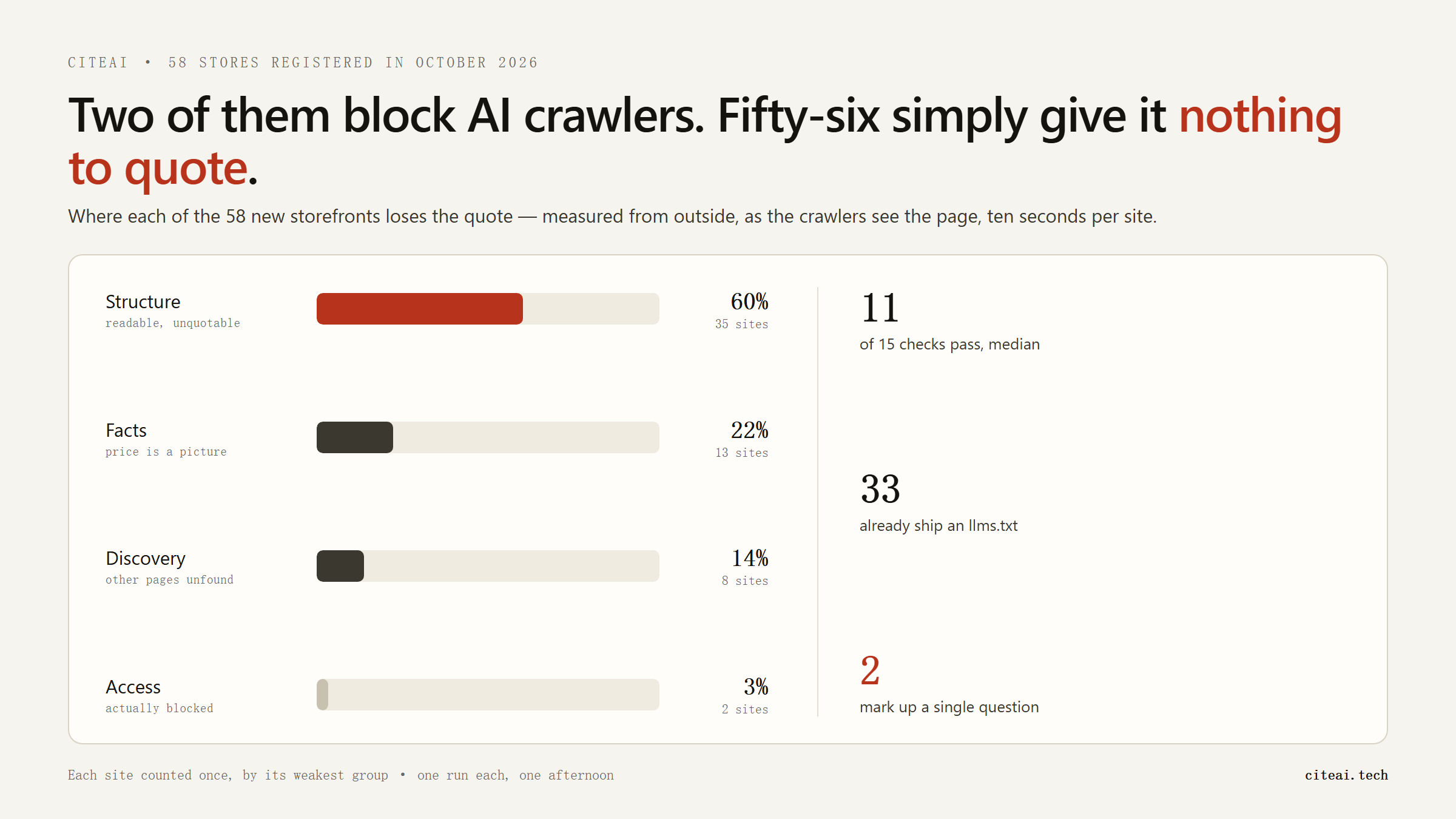
Thirty-three of fifty-eight newly registered stores are already serving one. Measured against whether an answer engine could actually use the site, the file separated nothing. Here is what it does, what it cannot do, and the version of it that is worse than having no file at all.
An llms.txt is a plain-text file at your domain root that summarises the site for a language model: a title, a sentence about what the business is, and a list of links to the pages worth reading. The idea is that a model reads one small file instead of guessing which of forty pages matter.
It is a reasonable idea, and it spread fast, which is why it is measurable: in a sample of 58 stores whose domains were registered in October 2026, 33 already had one and 50 had a working sitemap. Somebody is telling people to do this, and people are doing it.
What the measurement showed
Across the sample, having an llms.txt did not separate the sites that could be quoted from the sites that could not. The median store passed 11 of the 15 checks with the file or without it. What separated them was whether the page contained a sentence worth lifting, and whether anything marked up which paragraph answered which question: 2 of the 58 had FAQ markup.
That is not evidence that the file is useless. It is evidence that the file is not the mechanism. It is a map, and a map does not put anything on the territory.
The failure that makes it worse than nothing
A file that lists URLs which do not resolve is worse than no file, because a model that follows the map finds nothing and learns the site is broken rather than that it is quiet. Two failure shapes show up constantly:
- Templated links. Generators publish their route table instead of their sitemap:
/products/{slug}returns 404 if a crawler takes it literally. - Links that redirect to the homepage. A 301 to the front page is worse than a 404: the claim that belonged to
/pricingnow resolves to a page that does not contain it, so a model either drops the citation or attaches the number to the wrong URL.
If you already have a file, the cheapest useful thing you can do today is check every link in it. Not with a browser, which follows redirects happily: request each URL, and require a 200 with a canonical that points at the URL itself.
How to write one that earns its place
If the file is going to exist, write it the way you would write a one-screen brief for a stranger:
- One sentence on what the business is, in the same words a buyer would use, not the internal product name.
- One sentence on who it is for, with a place name if the business is local.
- Prices as numbers. A range is fine; a range written as "affordable" is not.
- Five to fifteen links to the pages that actually answer questions, each with a four-word description.
- No placeholders, no templated paths, no redirects.
# Northside Dental
> A family dental practice in Mesa, Arizona. Cleanings from $95, no insurance required.

- [Prices and what is included](https://northsidedental.com/prices): every treatment, as text
- [Same-week appointments](https://northsidedental.com/booking): how booking works
- [Insurance and payment plans](https://northsidedental.com/insurance): what is accepted
Where to put your effort, in order
The file is the second hour. The first hour goes into the page itself, because that is what gets quoted:
- Three plain sentences near the top: what it is, who it is for, what it costs.
- Headings phrased as the questions buyers actually type.
- Markup around the answers the page already gives.
None of that is a file. All of it is text somebody has to write, which is why it is the half that is still missing everywhere — and why it is where a competitor can pass you.
What the thread added, measured
After this went up, three questions came back that deserved counts instead of opinions, so I ran them over the same 58 domains.
How many of the files actually describe anything
Thirty-three stores answer 200 at /llms.txt. Thirty-one of those are real text files; the other two return an HTML page, which is the 200-with-a-homepage trap below. Of the 31 real ones, 19 list bare URLs with no description of what each page answers, and 12 describe at least one link. A file that lists URLs and says nothing about them is a sitemap with extra steps.
How many carry a price that is already wrong
Only 3 of the 31 mention any price at all, and 2 of those three disagree with the current page. The stale-file worry is real but rare here, mostly because a plugin writes the file once and never puts commercial detail in it. The failure that matters more is silence: 28 of 31 files would tell a model nothing about what anything costs.
Do the stores with a file score better on structure
No. Median structure pass rate is 0.33 with a file and 0.33 without; the means are 0.39 and 0.30, which at n=58 is noise. Having the file is not a proxy for having a quotable page.
What an edge log says that we cannot
Everything above is measured from outside, which is why one developer's logs are worth more than any of it. Nahuel Giudizi, who builds the free resume builder Folium, pulled the request counts from Cloudflare's zone analytics for his own domain in two separate seven-day windows.
| Window | Requests for llms.txt / llms-full.txt | Requests for everything else |
|---|---|---|
| 7 days before 19 Oct 2026 | 22, all from browsers, curl and SEO tools. Zero from any AI bot. | OAI-SearchBot 428 · ClaudeBot 320 · ChatGPT-User 295 · PerplexityBot 261 · GPTBot 56 |
| 7 days before 14 Nov 2026 | 10, again none from an AI bot. Zero, second window. | ClaudeBot 457 · PerplexityBot 315 · OAI-SearchBot 151 · ChatGPT-User 149 |
In both windows ChatGPT-User fetched the homepage more than any other page, and robots.txt on that site allows every bot, so the zero is not a block — it is a lack of requests. Two caveats he asked to keep attached: the dataset is sampled, so treat the bot counts as approximate, and a zero in two weeks is not a zero forever.
What it changes about this page: the file is cheap, harmless, and currently unread by the bots that could act on it. Write one if you like — 15 minutes, and it cannot hurt if the links resolve. Then spend the afternoon on the sentences, because those are what get fetched.
Check the file you already have. The free check verifies that /llms.txt resolves, that it is text rather than an HTML page, and that the links inside it return what they promise.
Frequently asked
Should I write an llms.txt in 2026?
Yes, after the page says what it sells in plain text. It is fifteen minutes, it cannot hurt if the links resolve, and it is the only summary on your site that a crawler reads identically every time — unlike a homepage that A/B tests two variants.
Will it get me cited by ChatGPT?
Not by itself. Citation needs the page to contain a quotable sentence and the engine to retrieve you at all. In the 58-store sample the file made no measurable difference to either.
What goes wrong most often?
Links that 404 or redirect to the homepage, and a file that describes the company rather than the products. Both are caught in a minute by requesting each URL and reading the status.
Is a 200 enough for the file to count?
No. A site can answer 200 at /llms.txt with its homepage HTML, and a checker that looks only at status codes will record that as a pass. Require the response to be text and not to start with a doctype.